

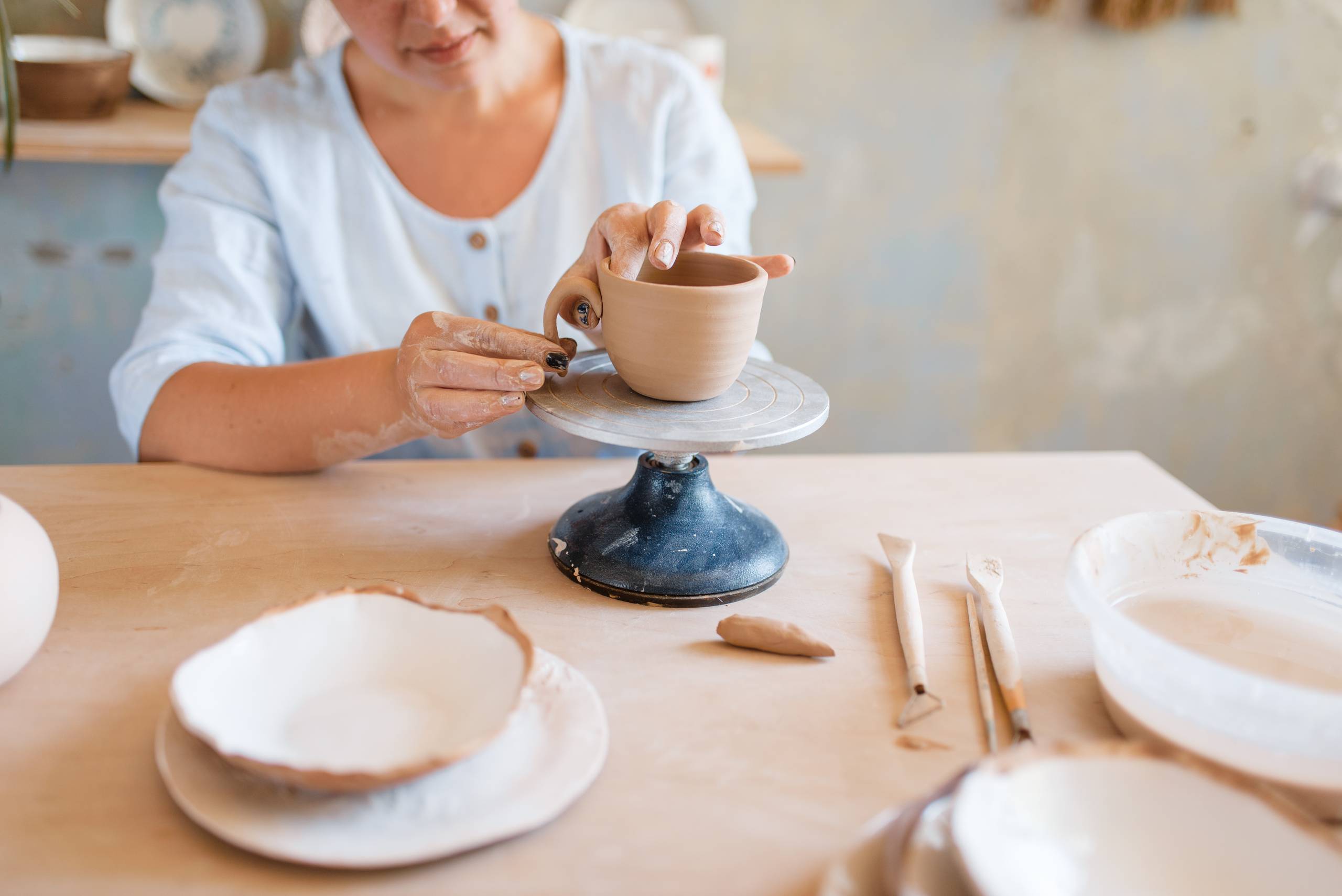
Patience is a virtue. At least, that’s what they say. In ceramics, patience is more than a virtue — it’s a necessity. But why is patience so important in ceramics? In this post, we will discuss why patience is key to improving your craft and building a long-lasting career as a ceramic artist.
A potter will tell you that the fastest wedging, throwing, or glazing possible is seldom the best. There’s a meditative aspect to working with clay that requires patience. The clay must be given time to sit. It must be allowed to dry. It must be tested with a stress to see how it will react to fire. In slowing down, the artist affords themselves the opportunity to allow every action to be a gesture. A hurried gesture will form a pot that will still hold soup, but a slow one will hold a moment.
You may have your first experience of patience when centering the clay. As you begin to spin the wheel and place your hands on the clay it may well resist your best efforts until your body finally settles into the motion. That point where the clay ceases to resist is not because you forced it to behave. It is because you slowed down and worked at the tempo of the clay. An experienced potter doesn’t force the clay to do their bidding, they pay attention to it. Later on you will experience the need for patience as you try to put a foot ring on a pot or add layers of slip to the surface. The timing of when to add the next layer is critical. If you don’t wait long enough the vessel will crack. If you wait too long the joins may be weakened. Patience is not just about waiting. It is about paying attention and waiting.
With firing, patience is put to the ultimate challenge. Once the work is in the kiln, all control is relinquished to the firing schedule and the atmosphere. If the kiln is opened too soon, the work will dunt. If it is cooled too quickly, even the most resilient piece will crack or blow up. Those who have suffered through many failed firings understand that the most crucial and time-consuming aspect of the process—the waiting—is the one over which they have the least control. The kiln is a patient master, teaching all who use it that you cannot rush the process.
The ultimate benefit of slow ceramics, then, isn’t mastery, but mindfulness. A piece of slowly crafted ceramics imbues the space it inhabits with the relaxed state of its creator. It sits humbly among faster made objects, inviting our gaze with its stillness, rather than its spectacle. To those who choose to tread this path, working with clay ceases to be a mere activity, and becomes a lifelong dialogue with material, hand and time. In this practice, mastery can never be fully achieved, but is always approached, incrementally, with each step.