

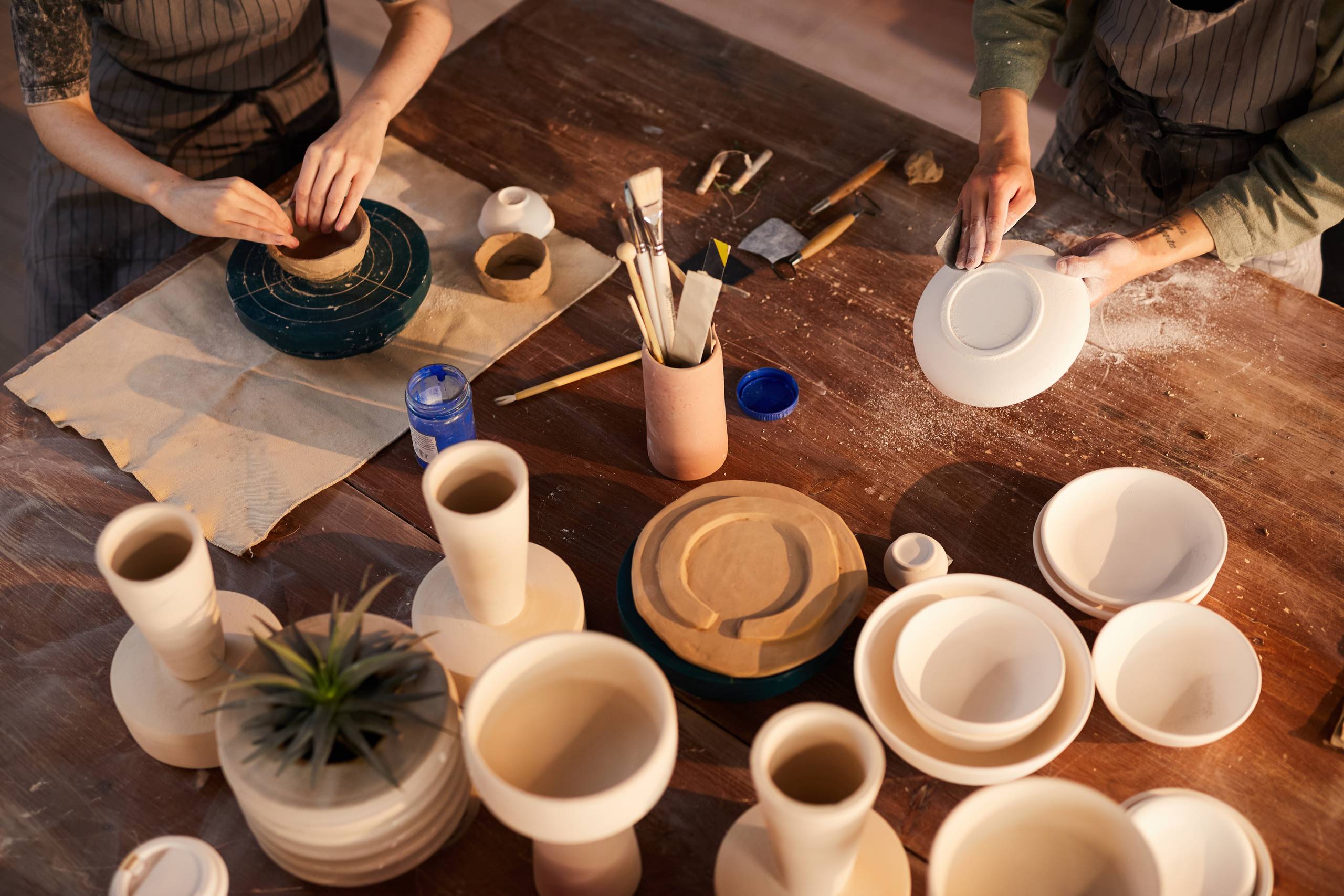
Glaze is the last conversation between the artist and object. It’s a combination of powder mixed with water that is applied, and then in the kiln, it becomes a shiny, glassy surface, a flat, matte finish, or forms crystals. It’s an element of unpredictability, but it also tells the truth. It reveals every decision you made leading up to it, how thick or thin you applied it, how you poured it, how you handled the object while it dried. You can’t always predict what the surface will look like in its raw state, and sometimes it surprises you. If you’re hasty in your application, it will crawl, pit, or deaden the object.
The glazing process also has its own language. Brush marks can be used to indicate where glaze is applied, with more dense or less dense marks depending on the application. We can also use dipping to create an even layer, though this will still show thinner areas where the glaze collects at the edges of the rim or where the glaze meets the foot ring. Pouring the glaze over a tilted object will display runs, where the glaze is allowed to flow and then be stopped in its tracks when the kiln is turned off. Spraying will also give a more uniform application, though it can also display a fog around relief carvings.
As essential to the results as the ingredients, firing conditions can control how a glaze reacts. Oxidation firing preserves the clarity of color; copper glazes, for example, fire to bright turquoise while iron glazes fire to a warm red. Reduction—by starving the kiln of oxygen—requires the firing process to find the color within the glaze; as a result, celadons become misty and shinos grow orange-peel in texture and flashing. The firing of wood, salt, or soda injects ash that pours down and pools in random ways, developing glaze “runs” and subtle differentials in tone that studio kilns cannot mimic. Even the timing of the firing can influence the final effects. A slow ascent to temperature fosters the formation of crystals, while a sudden descent preserves the rough texture of a matte finish that, otherwise, would melt into a gloss.
Lessons also come from our failures. Pinholing may be due to gas bubbles rising to the surface too fast, crawling from differences in shrinkage between glaze and body, and crazing from differential contraction during cooling. The knowledgeable artist has already accounted for these by doing sample firings, changing the proportions of silica and alumina, and by applying multiple layers of glazes to serve as a ‘buffer’. Eventually this process of trial and error becomes second nature: when a glaze needs more flux to make it more runny or more refractory to make it more durable. Ultimately, the best glazes are not perfect, just transparent to the artist’s fingerprint, bearing the faint imprint of the kiln’s moods and of an artist still learning.
Ultimately, glaze gives the long life to the ceramics that begin in the rotation of the wheel. A successful matching of glaze and form calls attention to the variation of gloss and saturation. The humble containers that we use every day are given a history through the application of a worthy glaze. This is why, despite the frustrations of an untrustworthy kiln and unexplained results, many who glaze will continue to do so: It is the conversation of trial and error that glazers endure for a lifetime. As one continues to glaze over the years, a distinct signature develops like a fingerprint in the realm of color. The signature of the glaze always connects back to the individual who first modeled it in clay.