

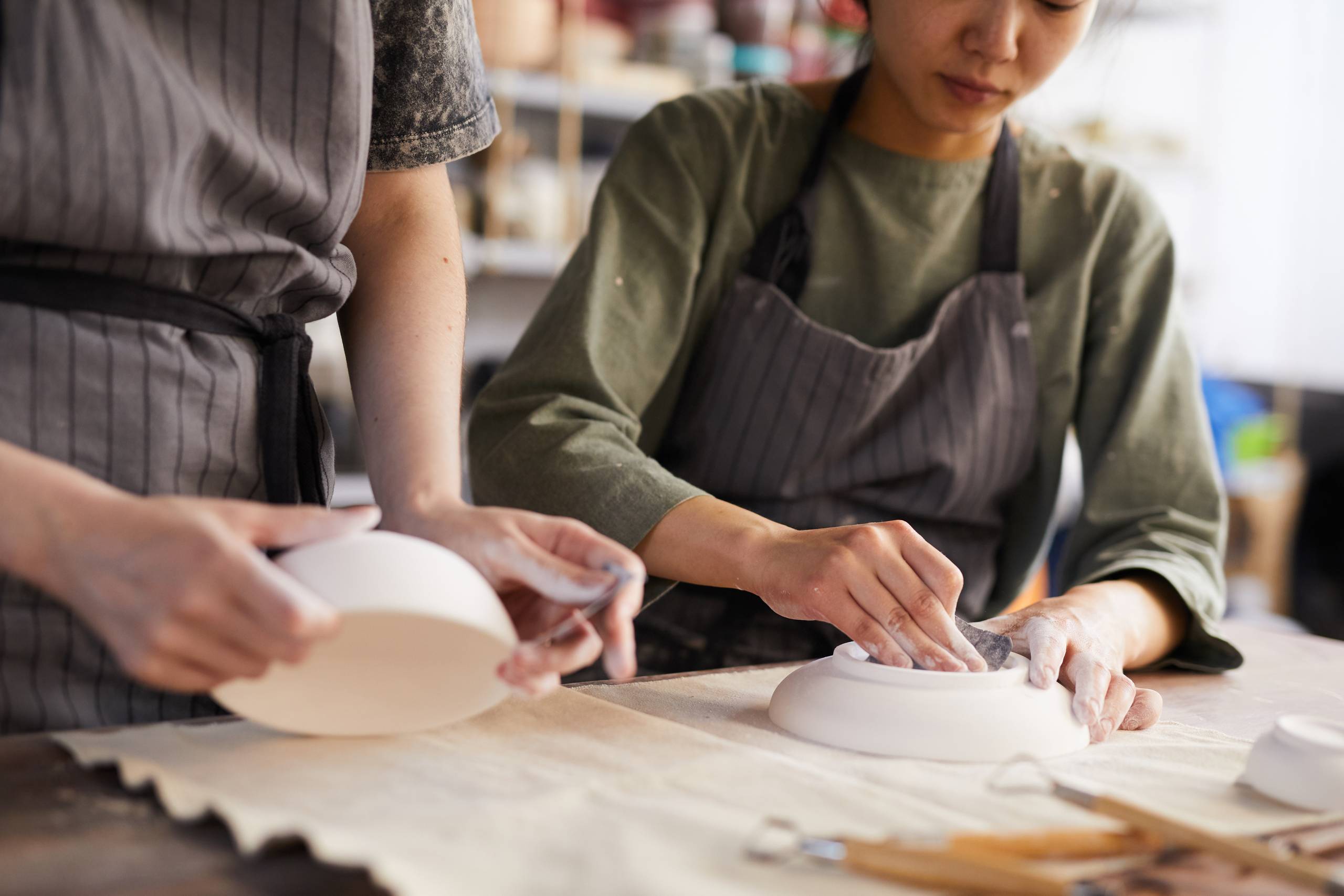
The beauty of handmade ceramics often lies in its subtlety. We are quick to praise a beautiful form, but more hesitant to acknowledge the equally important contribution of surface texture. When used thoughtfully, texture can elevate a pot, adding an extra layer of depth and interest to the overall piece. In this post, we will discuss the role of texture in handmade ceramics and explore the ways in which makers use this element to enhance their work.
More than any other aspect, texture carries the voice of clay. It can make a basic object appealing to the hand as well as the eye. While color and shape can be enjoyed from afar, texture needs a close approach. The sensation of running a finger along the grooves of a carved bowl, the subtle swell of a surface pressed by a thumb, convey deliberate (or perhaps unconscious) choices that animate the object. In handmade ceramics, texture is never embellishment for its own sake, but a record of the relationship between creator and medium.
Mishima is inlaying colored slip into lines and shapes that you’ve carved and then scraping away the slip to leave clean inlays. You can even use something as simple as a wooden rib or a shell or even a length of twisted twine to make rhythmic impressions that, depending on the angle and speed that you move the tool across the surface, will show up variably as the light hits it on the curvature of the form. They all leave evidence of speed, angle, and pressure. It’s like writing on a three dimensional surface.
The drying process also has its own distinct characteristics. Depending on the rate of drying, sometimes the object will develop small distortions or minute cracking, particularly if it is on the larger side. Potters often embrace these characteristics and allow them to influence the piece, perhaps accentuating the drying crack with a similar visual element in the glaze. The varying rate of shrinkage of different thicknesses of clay can also be utilized in the same way, exploiting the unique variations that can be achieved through manual construction methods. This ability to embrace chance requires confidence that the process will yield a desirable result.
Then there’s glaze. Mat glazes drink in light and highlight the textures created through carving and stamping; glossy glazes bounce it around, illuminating the marks that underlie it. Crawling glazes retract in carefully placed patches to reveal the body beneath in random splatters. Volcanic or crystalline glazes burst and unfurl during the glaze fire to produce shifting vistas when turned. The best glazes enhance the underlying clay — they have a dialogue with it, allowing the body’s texture to affect how the glaze fractures, gathers, or crackles.
Ultimately, the texture of ceramics is a matter of integrity. It can’t be deceivingly enhanced or photoshopped post hoc. Each impression testifies to the object’s manner of construction, drying, and firing. If done carefully and patiently, this integrity becomes the piece’s greatest asset. A textured object does not roar; it hums, beckoning the hand and eye back to it again and again to find novelty in something that is known. Practitioners build over years a lexicon of touch, one as particular as a signature, and as ancient as the medium itself.